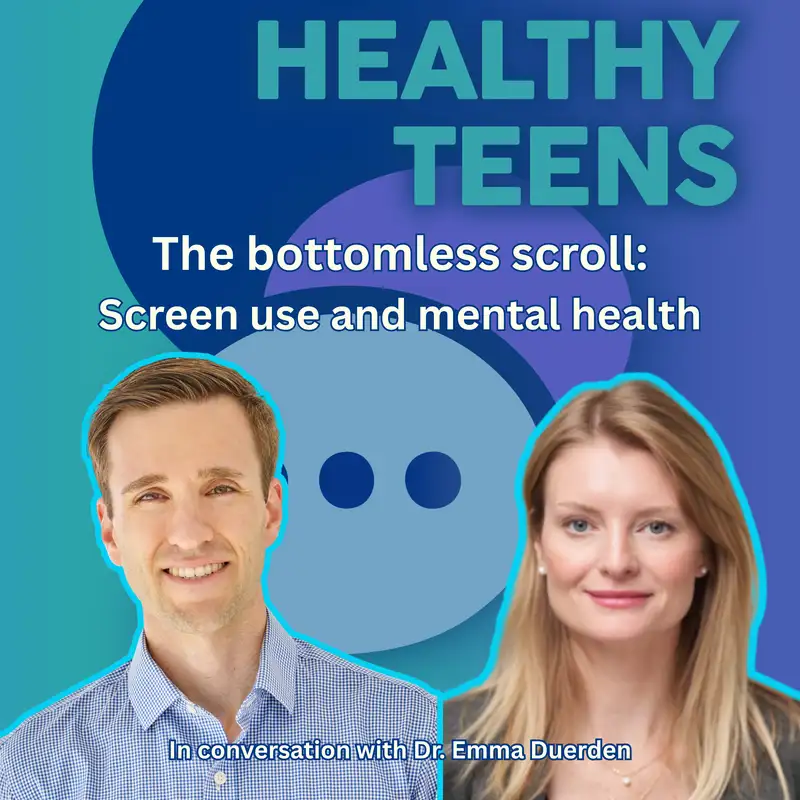
The Bottomless Scroll: Screen use and teen mental health
The Infinite Scroll: Excessive Screen Use and Teen Mental Health
===
Nicholas Chadi: [00:00:00] Every generation has a defining stereotype stemming from shared cultural events, historic events, or as we'll be focusing on today, significant technological changes in the formative years.
This generation's stereotype could well be a kid hunched over their smartphone, seemingly oblivious to the world around them.
As a Paediatrician specializing in adolescent medicine, I know that teens can't be shoehorned into a stereotype and that if anything, they're more connected and empathetic to the wider world than earlier generations were. So what's really going on? We know that two things are true. Teens today are spending much more time than ever on screens and teen depression and anxiety rates are up.
But are those two truths connected? When it comes to screen use in teens, how much is too much? Does it matter what they're doing on those screens and what's going on in their brains when they're spending so much time on their devices? [00:01:00] To shine some light on the matter, I spoke to Dr. Emma Duerden, Canada Research Chair in Neuroscience and Learning Disorders, and a member of the centre for Healthy Screen Use's Expert Advisory Board.
This is Healthy Teens, a podcast from the Canadian Paediatric Society. I'm your host, Dr. Nicholas Chadi.
Nicholas Chadi: Dr. Emma Duerden is an associate professor at the University of Western Ontario . She leads the developing brain research program studying how babies, children, and adolescents learn and interact with others.
Emma, hi.
Emma Duerden: Hi. Thanks for having me on the show.
Nicholas Chadi: It's a real pleasure to have you. Maybe as we start, can you tell us just a little bit about you and, and maybe what led you to take interest in the mental health effects of screen time among teens?
Emma Duerden: Yeah, so my students train to become [00:02:00] school psychologists and counseling psychologists, and we also have a university clinic in which we offer services in the community for children with mental health issues. I'm also a researcher, uh, so my lab focuses on early life stressors, including digital technologies. And we actually began studying this only in the pandemic, so only five years ago. And we had conducted some surveys to find out how much time children were spending online outside of, uh, school time. And, uh, we asked them, how much time were they spending on screens during the pandemic and then how much was it before the pandemic? And yeah, we were just
um, really surprised by the numbers. It was just really shocking, you know, screen time had tripled in children during that time period, so from about two hours a day to six hours a day during the pandemic. [00:03:00] And, uh, we followed 200 Canadian children for three years tracking screen time with their mental health and how they're doing at school.
And also found that screen time really remained high during and after the pandemic, and it impacted the children's mental health. So it's associated with higher rates of anxiety and depression.
Nicholas Chadi: Thank you so much , for sharing this, and for all the work you've, done in this . Um, I don't know where to start. So many questions and really interesting points you've brought up already, and I'm just thinking of this tripling of screen time during the pandemic.
I mean, we've talked about it, you know, young people spending a lot of time behind their screens, but three times more is certainly a lot. Maybe if you could share, Emma, um, how are teens' brains different from adults' and, you know, is there something that makes them more vulnerable to the harms of excessive screen use?
I know you've done some research on brain imaging, but maybe you could tell us in some simple terms, how's that developing brain different?
Emma Duerden: So the teen brain can be [00:04:00] more susceptible to the adverse effects of social media due to a developmental mismatch in the brain. So we have the brains reward centres and these brain regions are gonna be lighting up with likes and shares, and of course, uh, this part of our brain comes online very early, in infancy.
Uh, children, they love rewards. You can get children to do a lot of things if you are gonna offer them a reward, right? But at the same time, our frontal lobes, our decision making centre, the front part of our brain, this part of our brain is responsible for decision making, for impulse control, emotional regulation.
And that part of our brain actually develops last. So, for car rental companies, some of them will only rent people over the age of 25. They know that young people are more likely to take risks right? Because their frontal lobes are not yet developed.
So in turn, for children and teens, they can be more likely to wanna go on social media with each like and share. Uh, [00:05:00] the more sensational the information, the more it's gonna get picked up and shared and liked. So they're drawn into that. But at the same time, they may not have the adult machinery, brain machinery to be able to put the phone down.
Nicholas Chadi: Okay, that makes sense. So on the one side you have kind of increased sensation seeking or pleasure seeking that comes with adolescence and then this part of the brain that's more rational, that's not fully developed yet to keep you in check . That makes a lot of sense. And you're talking about brain development, but do we have a sense that some teens are more at risk than others when it comes to more negative mental health effects related to screen use?
Are there teens who are predisposed or, you know, is it related to how young people may be using their devices? Any thoughts about that?
Emma Duerden: Yeah, so definitely, um, underlying mental health disorders such as anxiety or depression. Research has shown, in teens and adults as well, that they can be more likely [00:06:00] to use social media, and then be more likely to suffer from the adverse effects. There's actually, there's not that much research in children with neurodevelopmental disorders.
But you know, 15% of the population can be neurodiverse. So this would be attention deficit hyperactivity disorder, autism spectrum disorder. We actually do have a study with, uh, with children with neurodevelopmental disorders and their screen use. But when we were looking in the literature there.
There's not that much. So for some children with ADHD screens may not even hold their attention enough to keep them on. Or for some of them, who can, uh, have the extreme attention hyperfocus, they could actually use screens more. as well For children who are on the spectrum for autism, who can sometimes have difficulties with social communication and in-person conversations,
uh, this can be mitigated by, by screen use. So, uh, because they [00:07:00] can have social relationships without, uh, the in-person eye gaze, that could, in turn, they could use screens more, uh, rely on screens more, but then spend more and more time on screens, which we know is a risk factor for adverse, uh, mental health outcomes, as well as adverse physical health outcomes too.
Nicholas Chadi: So there may be sort of a fine line between what's too much, depending on some past history that you have or neurodevelopmental condition you may have.
Can you tell us a little bit more about what excessive social media use is and would be?
Emma Duerden: Yeah, so for the average teen in Canada for our studies and those, uh, across Canada, they know that teens spend about three hours a day on social media on average. In our studies, uh, we do see upwards of eight hours a day, 10 hours a day. Uh, so a lot of variability there. [00:08:00] And our research indicated that those teens who are on social media for more than two hours a day could be at greater risk. Of course, it's very difficult to quantify it exactly because we didn't have timers on people's phones.
So some social media is okay. Excessive social media use is when it could be concerning and place people at risk. Really trying to stick within the two, three hour mark could potentially go a long way in promoting teen mental health.
Nicholas Chadi: That's very interesting. And I'm curious to hear your thought on the fact that screen time, you know, may lead to mental health problems or exacerbate.
But would the opposite also be true that if you do have mental health problems that are maybe left untreated, might you be seeking comfort or betterment by using screens and social media.
Emma Duerden: Yes, absolutely. So for social media research, there's hundreds, if not thousands of studies [00:09:00] published on it. It's a, a hot topic, right? There's millions of social media accounts. Something like 92% of teens, I saw a recent statistic in Canada have social media accounts.
They don't all have mental health issues, right? Otherwise this would be another pandemic or epidemic. Uh, so there's clearly gonna be more vulnerabilities, as a result of that. A lot of the research that's actually done even today, it's often done just at a single time point. And so they're kind of measuring how much time you spend on screens and what you're doing on screens, and then relating it to mental health outcomes on that day. So, uh, as a result of that, it's hard to see the causation, right? Which came first, you know? But there, have been longitudinal studies, um, as well, that have shown that excessive social media use
can predict anxiety and depression as well as randomized control trials where [00:10:00] they have some teens who are in a low social media use group and then, um, like a regular or high social media. And then they track their mental health outcomes. And for teens who spend less time in those trials on social media, they report better mental health outcomes.
Of course, social media, it's so complex. People are seeing and doing different things. And it's also difficult to evaluate the research sometimes because social media has changed so much since 2000 and six or seven when Facebook launched. Right. Uh, before the algorithm.
Yeah. Right. Yeah. So yeah, social media used to be just posting and sharing things with your friends, right? And now it's changed. With TikTok. Uh, there's, uh, new features of Instagram. For example, chatting with AI bots who are characters like a Harry Potter character [00:11:00] or also the location finding feature, uh, that you can have your location be constantly tracked.
These are new features that are coming out all the time and it's very difficult for research to stay on top of it, right? And to, you know, catch a tiger by the tail.
Nicholas Chadi: Well, I mean, thanks. I think that's a really important message to, uh, to keep in mind as a parent, uh, being one myself.
Maybe you can tell us a little bit about changes or impacts that a parent may see in a young person. So sometimes young people will tell their parents that they're using their devices for this and that, but sometimes they may not.
So I would assume that some parents may see changes in mood or behavior linked to screen use, and based on your work, looking at physical brain structures and how that can really change with screen use. Can you speak to that? What changes could we see in a young person and what would that indicate in terms of brain health?
Emma Duerden: Yeah. So for some teens who are using social media excessively, [00:12:00] um, these companies, they've designed the bottomless scroll to catch our attention, right? That's what they want. They want us to be on there. And, uh, for some teens this can be really, really captivating.
Also, for a lot of teens, uh, they have to post and like each other's posts, and this is really important, right? If you don't respond to someone's post, or people don't respond to yours, then this is, you know, socially this is becoming an issue. So they have to kind of be online and connected.
It's often the way that young people will meet, they wanna find out about their socials first. Right? Uh, so for some teens who are, you know, using it excessively, they're staying up very, very late at night , scrolling online, uh, they can even show behaviors, like irritability, distractibility, the brain fog that can come with excessive screen use and they're not gonna wanna give their phone away, [00:13:00] right?
Other products that have the potential to be addictive, something like alcohol or gambling. They can be used up, right? An alcoholic can drink all the alcohol in the fridge, or a gambler can spend all of their money. That's gonna be empty, right? But for social media, it's a cup that never empties.
Uh, so that's when it becomes, you know, a very, very slippery slope to be monitoring and I think, uh, to be monitoring children's behaviors. So once it's starting to interfere with sleep, you know, daily activities, if they're becoming very irritable, they don't wanna give up their phones, and they become, you know, even crankier and show aggression and that sort of thing, um,
the brain fog. These would be indicators. And so many parents report this, right? So many parents are concerned about this.
Nicholas Chadi: So several red flags that parents could report both in behavior and wellbeing, and also just daily structure, right? If you can't find the time to sleep or eat or do things [00:14:00] that teens normally do. And would you say that that would translate in into actual images of the brain? Like can we actually see the impacts of social media use?
Like we, we may be able to see with substance use further sort of addictive behaviors.
Emma Duerden: Yeah. Well that's really the it is the million do million dollar question or the, I don't know what dollar, what dollar amount it is, but this is right. It's to show that it's associated with changes in the brain. And so this is similar to addiction research in the seventies and eighties before we had brain imaging.
Addiction was seen as a social justice issue, right? People's rights and personal decisions to, uh, use illicit substances. And then when brain imaging research came out in the mid nineties or you know, early two thousands, that they're able to show actually it's associated with changes in the brain, in brain regions involved in addiction and reward, then it became a medical issue.
And the [00:15:00] World Health Organization was only then in the two thousands to, uh, address it as a medical issue where people didn't have a choice. They weren't making their own choices about how much they were wanting to use and about the impact on their physical health.
So will we ever be able to show this with, uh, social media in children? This is challenging to do because for some of that brain imaging research, it's invasive. And obviously we don't really need to do something invasive to children if we don't have to do it right.
So, for our research, we're actually, , one of the few groups in the world who are studying this. There's probably about 30, 35 studies published to date on social media use and its relation to brain structure and function.
Nicholas Chadi: So quite a bit.
Emma Duerden: Yeah. So not all exactly on the same thing. So studying various, you know, different things about the reward centres for likes or just like amount of screen time [00:16:00] and different age groups.
So, for our group, we're focusing mainly on brain connectivity, how it impacts social connectedness, how we understand thoughts and, uh, social connectedness in others, how it impacts learning memory and their mental health. So just studying brain function. Uh, and we do see with excessive social media use, kind of a, a disconnect between those brain regions, so our frontal lobes, the decision making centres with the reward centres.
We're also doing new brain imaging methods where we can study dopamine in the developing brain noninvasively. So we've done this safely in babies, toddlers, children, teens and young adults, all the way up to 21 years of age, uh, and tracking screen time. So we've done this in over a hundred individuals and we're now able to look at, uh, the changes in dopamine.
So the reward chemicals that are released when we are using social media. So [00:17:00] that's only recently were we able to do something like that in children in a safe way. So that's an ongoing study that I don't have results to, uh, share with. So just to say that there is a lot of research that's going on.
Uh, we don't have all the answers. But at the same time, you know, knowing that there's these guidelines out there and, you know, we want to mitigate risks, uh, definitely screen time, social media, these are modifiable risk factors for child development. So, , we have the opportunity here to stay on the safe side of things and try to avoid risks by just limiting screen time.
Nicholas Chadi: That sounds wise as we, we try to get more answers and you've mentioned there, is high quality and rigorous research looking at these questions from different angles, and there's certainly a lot to do. Being a researcher myself, I can appreciate that.
So. We've talked about scrolling and endless scrolling and how that in itself can be potentially unhealthy. Um, but I'm curious to hear, uh, does [00:18:00] this scrolling have an impact on, on attention span or the capacity to pay attention for longer periods of time? Knowing that a lot of social media content is quite short, um, 30 seconds. And you know, I've heard that young people sometimes won't be able to focus on content more than a few seconds at a time. Can you tell us more about that?
Emma Duerden: So scrolling social media is the ultimate multitasking, right? So when we multitask, we think we're getting more done, right?
And so we can be scrolling, you know, it's constantly switching. It can be aerial footage of a nature scene. And then the next second is somebody playing the piano. And then. The next second is gonna be, uh, a split screen, right? There's often these split screen reels with like a podcast at the bottom, but then at the top to like maintain attention
there'll be someone doing Minecraft, parkour, something like that. And so people did research on this multitasking, constant switching before social media. And, uh, there is really no such thing as multitasking. Our brains [00:19:00] as humans are not designed to be doing that.
When we're doing that, we're getting these quick, fast releases of those reward chemicals into our decision-making centre. And when we have this overload, this can impair, uh, decision making. That was, that's what leads to the, the brain fog. And this is demonstrated in animal studies as well as in humans.
So we know a lot about how rewards change the brain. And our brains just, aren't designed to have exposure to constant rewards all the time. You know, so this is the feeling, you know, when you're watching a sports game and your team scores a goal and you're like, oh, you have that elated feeling, you're driving in the car, listening to the radio, and your favorite song comes on, right?
You have that little rush. So that's the type of natural rewards that we're designed to be experiencing. We're not supposed to be having them you know, every second, every 500 milliseconds. And what we're seeing with, social media platforms that they're [00:20:00] even struggling to keep our attention.
Right. You know, for the ads that are on social media where these companies are getting a lot of their money from, you know, they are often like heavily curated, right? But the people are just. You know, they're swiping over them because they're just, you know, into that infinite scroll.
So it is associated with changes in the brain. And, it can be associated with difficulties with attention and focusing and planning and monitoring because of how having those excessive rewards, how it's impacting that decision making centre.
Nicholas Chadi: So there really is something to say about how this end endless scrolling can, can really affect your learning and your full intellectual potential we could even say.
And, you know, we're talking about mitigating risks and, potentially protecting our, our young people's brains. Are there some, protective factors for teens using screens or are there ways to sort of make it safer for young people to use screens? How would you approach that?
Emma Duerden: Yeah. You know, surprisingly for some of our [00:21:00] studies for the excessive screen time use in school aged children in particular, we found that what a protective factor was positive parenting. So encouragement, supportive parenting, uh, , you know, involvement with, um, schoolwork, with extracurricular activities.
So that's the thing that people can do in, you know, the day-to-day. We found, surprisingly, in a few of our studies, very surprising that parent stress levels were associated with higher screen use in children. So the more stressed you are as a parent, this is associated with higher screen use. So this was in school age children, six to 12-year-old children.
So we, we look less so at parenting factors in teens. Yeah, so that's something that parents can also try to get a handle on. We can do our best. You know, parenting is tough, right? And, and it's, it's stressful. Um, but these are things that, you know, we can do in the day to day.
I think also, managing, uh, your own screen use, you know, like modeling behaviors you like to [00:22:00] see. And then, you know, sometimes it's difficult to break habits and routines, right? We all have our routines with our families, and, you know, it can be, easy as you know, no screens first thing when you wake up in the morning, right?
So we don't start the day with being on screens. That's something that children often really wanna do is go on screens immediately. And it's often at like a loss of, self care, you know, like actually like getting ready for school and, you know, getting organized and packing the backpack.
And so this can often be like a big rush and make mornings chaotic. So, you know, that sort of thing, minimizing or having no screen time in children's bedrooms, especially before they go to sleep. Easier said than done, right? Try and have a screen free zone.
Screen free times like dinner time, but then also as a parent to not use screens. So you can't say, we're not gonna use screens and then be on your phone the whole time at dinner, right? So those types of behaviors, uh, they can help. At the same time though, I think often that's a big onus placed on parents, [00:23:00] uh, for screens, and, and I think it's tough.
Right. I think it's tough for parents because, you know, these are products being sold by companies or being distributed by companies. And we often expect them to be safe, right? You go to the store and buy a bike helmet for your child, you don't expect, you should have to research if it's safe or not.
So, I think a lot of onus is placed on parents, and I think this is, it's beyond the home. It's beyond the teens and the children themselves. And the parents themselves. I think, you know, this also has to have digital literacy in schools and public health awareness and legislation and, and the companies themselves to make products that are safe for children.
Nicholas Chadi: Right, so, so, so many ways we can make it safer and some of it comes to what's happening in the home. And some of it is, way bigger and beyond that. And I really like what you said about positive parenting, but also taking care of yourself as a parent.
Uh, I certainly am not perfect with my own screen use it really helps to have screen free [00:24:00] times and, and zones, but it's not always so easy to do in real life.
And we talked about how some parents may be experiencing stress themselves, and how that can have an impact on, on young people's screen use and how some activities like extracurriculars may be protective, but it seems that it may not be that easy to get the help and support for mental health issues as a parent and even sometimes have resources and money to, to offer some more expensive extracurriculars. Do you have any words to say about health equity and how potentially, depending on your background, your social economic status, um, you know, relations with media use and healthy media use in the household can look different or be affected differently.
Emma Duerden: There was a recent Canadian survey that showed that children from lower income households were on screens twice as much as children from higher income households. So children from higher income households were actually on screens for about two hours a day. So within the [00:25:00] recommended, uh, guidelines by CPS and the WHO and children from lower income households were on screens for almost four hours a day.
So double. So this obviously does speak to a health equity issue. It goes beyond the need for digital literacy and education. This is for a lot of people, their day-to-day lives where, uh, they may not have access to parks or programming that's inexpensive or free, particularly in larger urban centres, right, where it's often really expensive.
And, you know, opportunities to support screen free activities. There are organizations like Boys and Girls Club, which support real in-person social interactions and screen free activities. This may not be accessible, right? So, for parents who maybe don't have a lot of other options, we know that the prolonged sitting with screen use is a risk factor for increased [00:26:00] insulin resistance and can place children at risk for a metabolic disorder like type two diabetes.
So even if they only have screens, promoting screen use that is educational or interactive, that involves movement.
Uh, then, you know, using it as an opportunity to do, you know, kids yoga or something like that. Something where they're moving, learning something, you know, learning, uh, the, digital piano or something like that, at least children are moving and engaged and thinking, uh, and interacting and, uh, could certainly offer more benefits than just passive sitting and passive scrolling.
Nicholas Chadi: So being creative, even with screen time, uh, even sometimes when resources may be, may be limited. Well, thank you so much, Emma.
Is there any final thought you'd like to share, perhaps? Um, you know, we talk a lot about all these types of social media platforms, how they, they quickly evolve, and how young people these days are really driven towards them.
Anything you'd like to share with our listeners today?
Emma Duerden: Yes. Well, I think definitely the [00:27:00] Centre for Healthy Screen use, which is part of the Canadian Paediatric Society. I think this is a great resource for parents and for teachers. I give a lot of public talks, and I often share the guidelines and the information and, and I think this is one of the few resources that Canadian families have. So I think this is really positive that there is this organization that is bringing people together with diverse backgrounds to address these really complex issues, right?
That, that people are facing every day with their children.
Nicholas Chadi: We'll certainly share links to these fantastic resources in the show notes. Emma, , it's, it's really been a pleasure talking with you. thank you so much for joining us today. It's been a really interesting conversation.
Emma Duerden: Thank you so much.
Nicholas Chadi: Dr. Duerden then gave us some key takeaways on what we can do to encourage healthier patterns of screen use by the teens in our lives. We can manage screen use with strategies like screen-free zones or [00:28:00] times, focus on meaningful screen use instead of that endless scroll and model our own healthy screen use.
For an idea that hits all those marks, I especially like the idea of screen free meals. They get the whole family to get on board and give you the opportunity for daily check-ins, and as a bonus family meals are known to improve nutrition, self-esteem, and family relationships. The Centre for Healthy Screen use has more resources, including tips on creating a media plan that works for the whole family.
Find them at HealthyScreenUse.cps.ca
Healthy Teens is brought to you by the Canadian Paediatric Society. Today's episode was produced by Gen Brouillette. I'm Dr. Nicholas Chadi. If you liked this episode, subscribe wherever you listen to your podcasts and share with a friend. Please send comments or ideas for future episodes to info@cps.ca, with the subject line, Healthy Teens.
Thanks for tuning in.
[00:29:00]